EQ
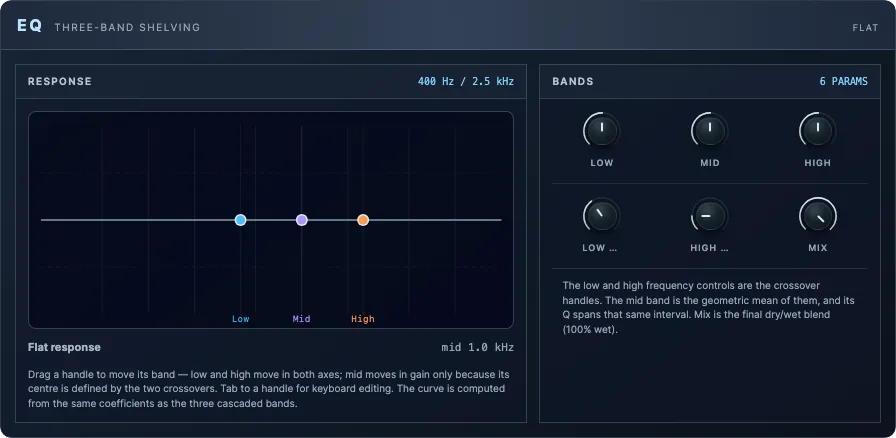
Three-band equalization with two crossovers.
Six bands, a curve you can drag, and a bit-exact bypass.
A six-band stereo parametric EQ with per-band type, frequency, Q and gain, an output trim, and fixed-role defaults in the classic channel-EQ idiom. With every band off and the trim at 0 dB it copies its input byte for byte.
Start from a named sound, then adjust the instrument to make it yours.
A sketch of the signal path, in the order of the parameter groups.
Six bands, each one a fused biquad that can be a bell, a low or high shelf, a low or high cut, or a notch. The defaults are the Logic-style fixed-role layout - a low cut at 30 Hz, a low shelf at 120 Hz, bells at 500 Hz and 2 kHz, with a high shelf and high cut present but disabled - so the module opens flat and every band is already where you would have put it.
The curve the editor draws is the design the kernel runs. Band handles drag for frequency and gain and take a wheel or modifier for Q, and the cut and notch shapes lock the gain axis automatically because they have no gain of their own.
Bypass is a guarantee rather than a tolerance. With every band disabled and the trim at exactly 0 dB the kernel short-circuits and copies the input, and the module's tests assert that byte for byte instead of measuring it against a threshold.
Stereo is two mono band-set lanes with identical parameters, the same pattern the Gate uses. Because the coefficients are identical and only the delay state differs, phase coherence between the channels is exact - which is why the node deliberately does not claim to be stereo-capable, a flag that means two decorrelated paths.
Three-band equalization with two crossovers.
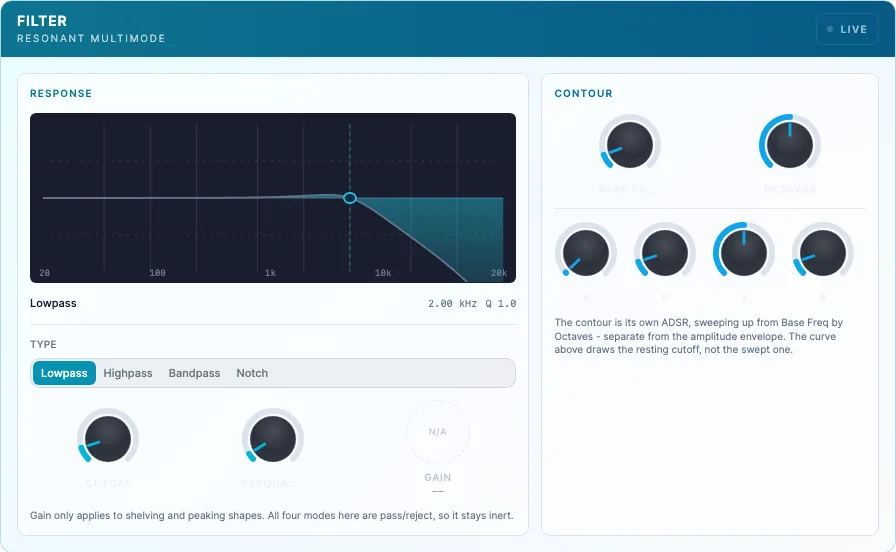
A resonant low-pass filter for shaping tone.
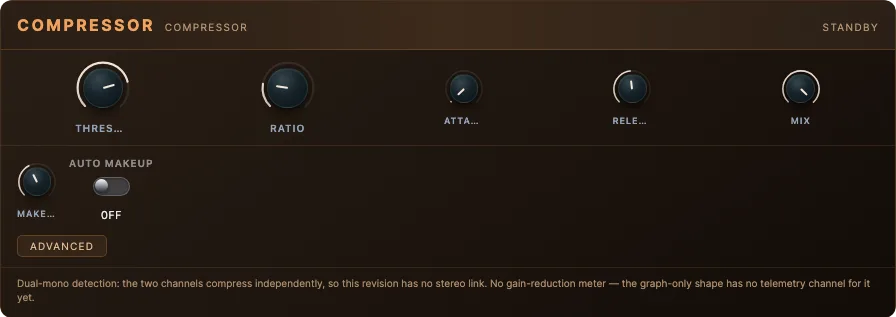
A full dynamics compressor with a filterable detector.
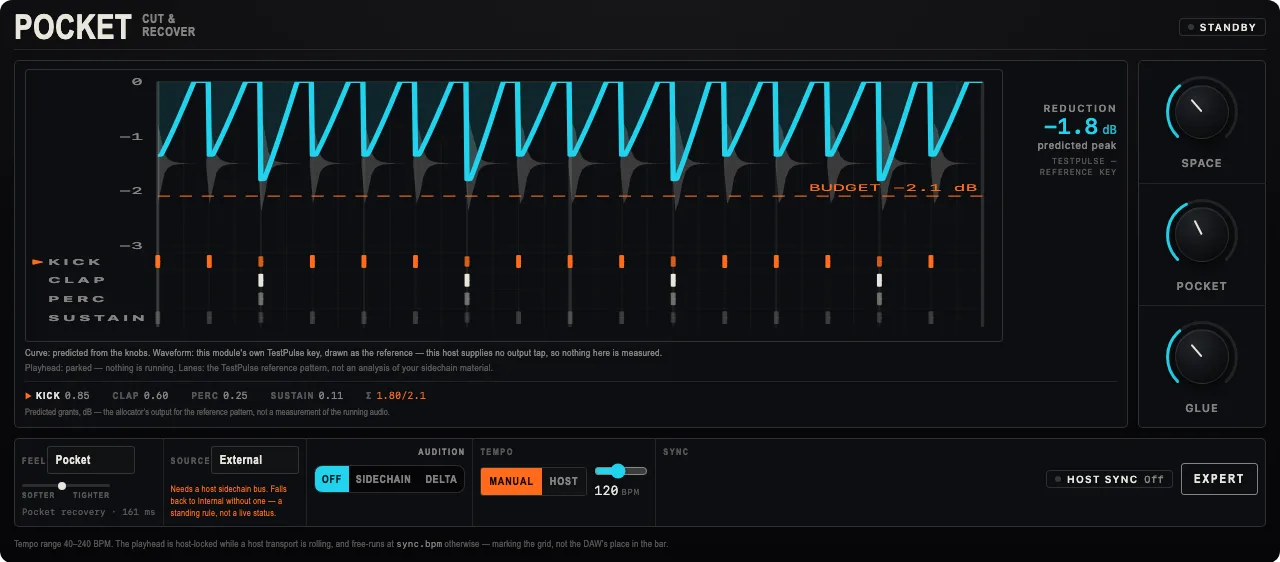
Sidechain that gives the room back in the groove.