Squeeze
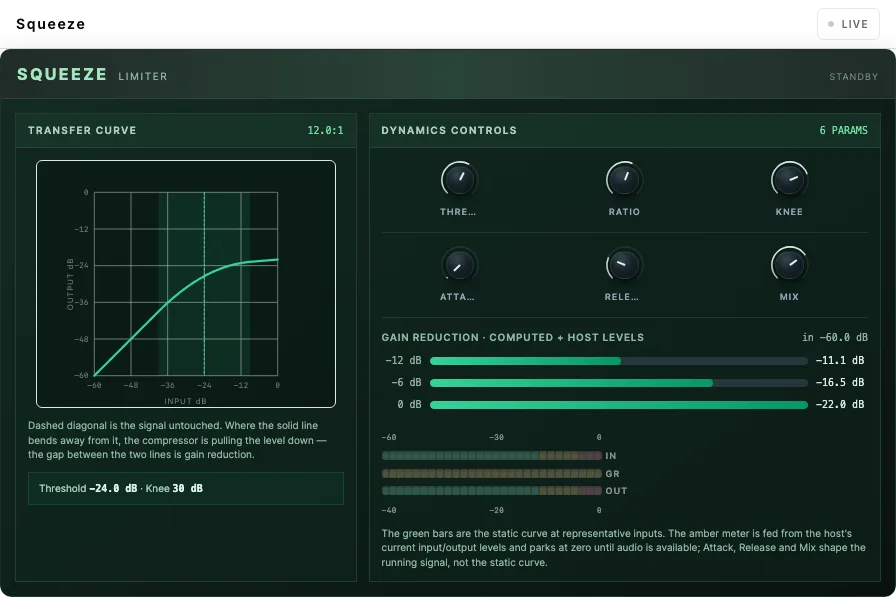
A compressor with visible gain reduction.
A noise gate with a clear threshold.
A noise gate: an envelope follower watching the signal level, and a gain that stays shut until the level clears the threshold. The effect that removes what you were not playing.
Start from a named sound, then adjust the instrument to make it yours.
A sketch of the signal path, in the order of the parameter groups.
An envelope follower measures the signal's amplitude, and that measurement is compared against the threshold. Above it the gate is open and audio passes; below it the gate closes and the output is silence. It is not a filter and it removes nothing from inside a note, it only decides, moment to moment, whether there is a note at all.
Smoothing is the follower's time constant, and it is the one control that decides whether this sounds like a gate or like a fault. Because the same constant governs opening and closing, a setting fast enough to catch a transient is also fast enough to chatter when the signal sits near the threshold, and a setting slow enough to be smooth will let the tail of a note through the gap after it.
The browser preview builds this from four plain nodes and no worklet. A waveshaper rectifies the input, a one-pole lowpass whose cutoff is 1/(2·pi·Smoothing) averages it into an envelope, a second waveshaper maps that envelope through a soft-knee curve, 0 well below the threshold, 1 well above, a smooth ramp across the boundary, and the result is summed into a gain node's parameter. The VCA's own gain sits at zero, so the follower is the only thing that ever opens it.
The knee is what makes this usable rather than a switch, and it is deliberately not a separate control. A hard comparator chatters whenever the signal hovers at the threshold, so the curve ramps across a small band either side of it and the follower's own smoothing does the rest. Everything is audio-rate, which is the part a polling meter cannot do: the gate reacts within a sample of the transient rather than at the next animation frame.